

In robotic laser welding, reducing setup times is essential for efficient production, especially for subcontractors or those producing small, highly variable batches.
To increase laser cutting productivity, it is possible to adjust cutting parameters and head dynamics appropriately to reduce cycle times. In laser welding, this approach is limited by essentially different technological processes.
In laser welding, in fact, the molten material is not expelled by the pressurized assist gas but must have time to solidify again in a controlled and protected manner, consequently the margin for increasing the speed of the process is much more limited.
In laser welding, to increase productivity, it is therefore essential to act on the efficiency of welding preparation, simplifying all the operations involved in this preliminary phase.
Among the activities that have the greatest impact on laser welding preparation time are:
- the positioning of the parts in the welding jig
- resetting the TCP* on the part, whether it is related to self-learning welding process programming or to a correction to the program generated offline
- the search for the most suitable welding parameters
*TCP Tool Center Point in laser welding corresponds to the laser focus.
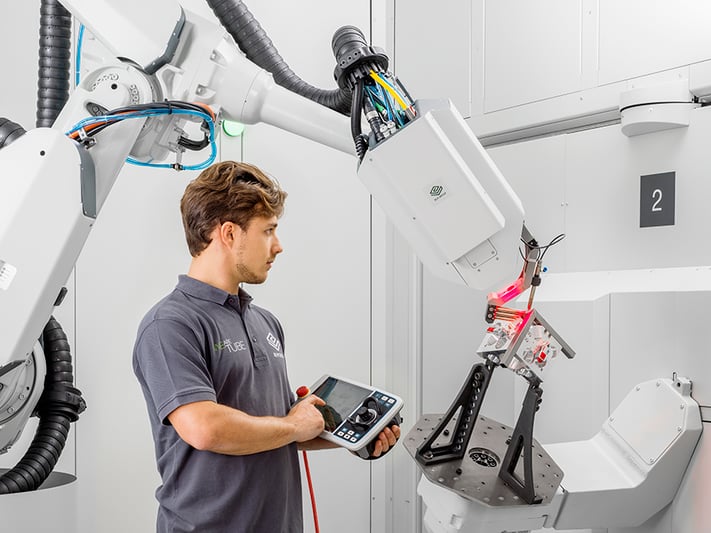 To increase productivity in laser welding, it is essential to maximize the efficiency of the preparation phase.
How to position the focus height of the laser welding head on the workpiece?
After the part has been placed in the fixture, there are two possible approaches: either program a path through self-learning, or align the theoretical model developed in the office with the CAM software for welding cell programming to the actual weld joint path on the part.
To perform this operation, the operator must correctly position the TCP (Tool Center Point) at the points of the joint to be welded.
In laser cutting, the focus is located near the tip of the nozzle and its position relative to the workpiece can be precisely determined using the capacitive sensor integrated into the cutting head.
In laser welding, however, this approach is not always applicable (unless you program with a coaxial nozzle, which however limits its subsequent use). In general, in laser welding, the focus is located at a much greater distance (up to 200-250 mm depending on the optical configuration).
This distance often forces operators to report the focus position on the workpiece using head-mounted probes, or, in the worst cases, manually measure the distance between a specific reference point on the head and the workpiece surface.
Both of these methods are imprecise and error-prone, as they depend heavily on the operator's experience. Furthermore, without direct visual feedback, it is impossible to verify the correct position of the laser focus on the workpiece surface, resulting in a risk of defects in the weld seam.
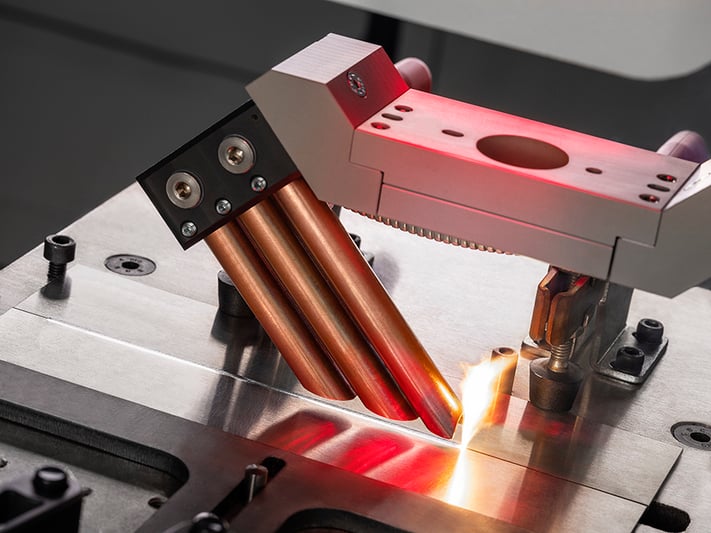 Welding on a stainless steel part. The laser focus is kept close to the surface of the part, approximately 200-250 mm from the head's optics.
Focus Assistant assists the operator in setting the focus height on the workpiece
Focus Assistant is the integrated system on BLM GROUP laser welding solutions that allows you to set the zero focus level on the part in a simple, precise and repeatable way.
The system is composed of three main elements: a projector that emits a laser line inclined with respect to the welding laser beam, a camera coaxial with the laser beam and a pointer in the centre of the view.
The setup is carried out through an extremely intuitive laser triangulation procedure.
The operator activates the laser line projector and, by adjusting the height of the head from the teach pendant, easily identifies the point where the laser blade and the center of the chamber meet; when this occurs, the focus is at zero height with respect to the workpiece.
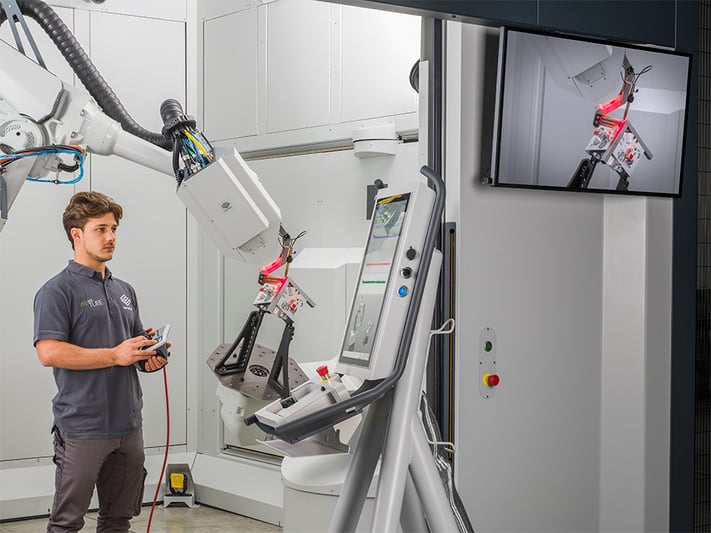 Focus Assistant used to triangulate the TCP zero elevation on the part.
How to set the head position relative to the joint
One of the main advantages of using a laser welding robot is the high repeatability of the process. However, this is only an effective advantage if the weld is performed at the intended position on the workpiece surface (the joint).
For this reason, the definition of the welding coordinates on the actual surface of the component must be carried out extremely precisely.
In the absence of dedicated instruments for laser positioning, operators are often forced to resort to manual and approximate methods, the outcome of which depends largely on their experience and is easily subject to random errors.
Process viewer assists the operator in aiming the joint on the workpiece
Here too, having a camera with a coaxial laser beam makes a difference. Through it, the operator can observe the joint being welded with a very high level of detail. It's like having the tip of a microscope constantly pointed at the part.
.png?width=711&height=423&name=immagine%20(1).png) Process Viewer allows you to easily locate the position of the joint to be welded on the part.
Process Viewer allows you to easily locate the position of the joint to be welded on the part.
To zero the laser on the joint to be welded, the operator brings the welding head close to the part and orients it perpendicular to the joint, then, with the aid of a pointer positioned in the center of the camera frame, moves the focus until it is positioned exactly on the joint.
The camera's magnification factor enables this operation to be performed precisely and repeatably by any operator, with extremely low margins of error. It is important to clarify, however: in many cases, parts may be affected by deformations or errors that cause the actual joint trajectory to deviate from the theoretical one in a completely unpredictable way. In these cases, to ensure the quality and continuity of the weld, in addition to the Process Viewer, we recommend using an automatic tracking system for the actual weld joint. This function is available on BLM GROUP laser welding cells and is called Active Tracking.
How to set technological parameters in laser welding
Correctly setting the technological parameters ensures a successful welding process. These parameters include the laser's own parameters, the assist gas pressure, the feed rate of any filler wire, the welding feed rate, and the type of laser beam oscillation in the presence of a wobbling head.
Setting these parameters requires time and experience and, especially when processing small batches or prototypes, can significantly increase production costs.
LW-S, the BLM GROUP laser welding cell, already has a very detailed database of technological parameters developed over many years of research and development dedicated to this technology.
Through the database, putting a new part into the machine is much quicker and the experience required of the operator is significantly lower.
Why choose the LW-S laser welding cell
LW-S is BLM GROUP's turnkey solution for robotic laser welding: an integrated and flexible cell composed of an anthropomorphic robot with a laser welding head available in both wobbling and fixed optics modes.
LW-S can be configured according to needs with various automatic workpiece handling systems, with the automatic cold wire feeding system and is equipped with a large technological database that allows for easy processing of the main metallic materials.
The welding head can be equipped with Focus Assistant and Process viewer to quickly, easily and precisely perform the main welding preparation operations: setting the height and position of the laser focus on the joint to be welded.
Furthermore, LW-S has special advanced features: Active Tools, such as Active Tracker and Active Monitoring that improve accuracy, reliability and robustness of the process even in the most demanding working conditions
.